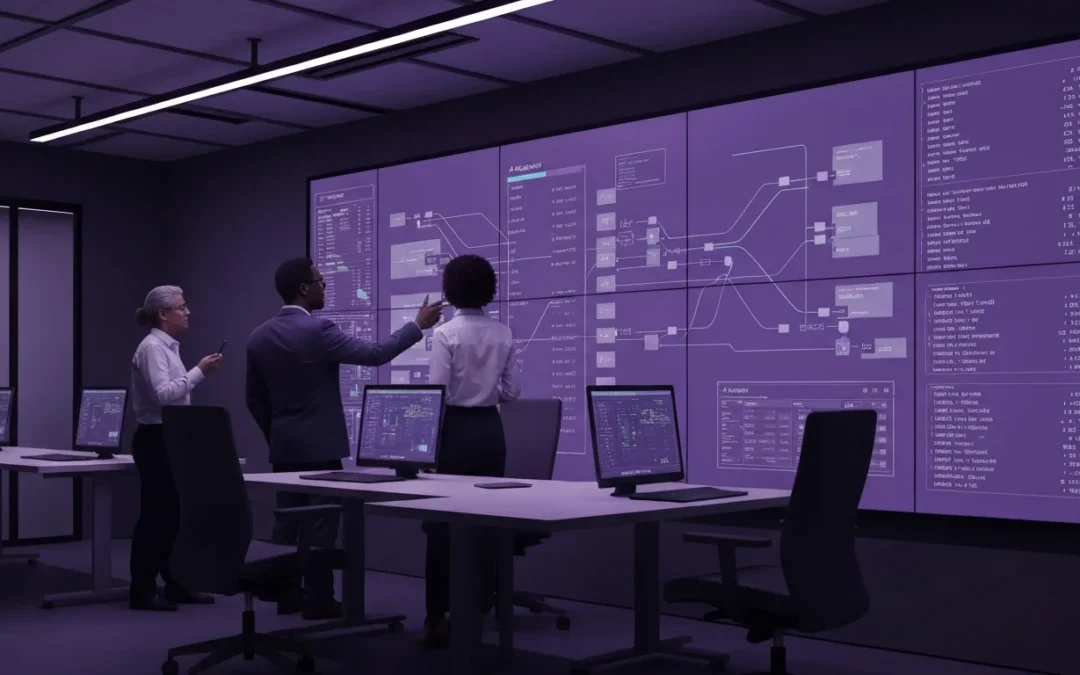
AI agents can look reliable in demos and still fail quietly in production. The gap is usually not the model itself. It is the lack of visibility into what the agent saw, decided, called, and returned.
In this article you’ll learn how observability helps teams catch failures earlier, reduce support noise, and understand which agent steps need fixing first.
Why observability matters now
As more teams deploy tool-using and workflow-based agents, small issues can become expensive fast. A bad lookup, a stale knowledge source, or a looping handoff can create customer-facing errors that are hard to reproduce later. Observability gives you the evidence trail.
[Internal link: ]
What to monitor in an AI agent system
Focus on the full execution path, not just the final answer. Useful signals include:
- Prompt and tool-call sequence
- Latency by step
- Retrieval quality and source freshness
- Retry counts and fallback usage
- Human escalation rate
- Cost per completed task
- Failure clusters by intent or workflow
When these signals are connected, teams can see whether the agent is failing at understanding, retrieving, deciding, or acting.
Common mistakes
- Only logging the final output
- Keeping traces too short to debug real incidents
- Ignoring tool errors that were recovered silently
- Measuring model quality without business outcomes
- Letting every team invent its own metrics
A practical observability setup
Start with a simple event model: request received, context assembled, tool call started, tool call finished, answer produced, and outcome confirmed. Add trace IDs so you can follow one user request across systems.
Then build dashboards around three questions: What is failing? How often is it failing? What business impact does it create?
What to do next
If you are early in your agent rollout, begin with high-value workflows such as support, intake, or internal ops. Add traces, logs, and a small review queue before you expand automation.
If you already have agents in production, audit one workflow this week and list the top three points where debugging is currently guesswork.
FAQ
What is AI agent observability?
It is the ability to inspect an agent’s behavior across prompts, tool calls, retrieval, decisions, and outcomes.
How is it different from regular app monitoring?
Traditional monitoring tracks uptime and latency. Agent observability also tracks reasoning paths, intermediate steps, and recovery behavior.
What should be logged first?
Log the request, the trace ID, tool calls, retrieval sources, retries, and the final outcome.
Can observability help reduce support tickets?
Yes. It helps teams identify broken workflows before users report repeated issues.
Do small teams need this too?
Yes. Even simple agents become hard to debug without traces and outcome data.
How do I know if my agent is improving?
Track success rate, escalation rate, average resolution time, and cost per successful task over time.
Further reading
- Official observability guidance from cloud monitoring vendors
- Vendor documentation for distributed tracing and structured logging
- Industry write-ups on AI evaluation and production debugging
- Platform docs covering workflow automation analytics
Strong observability turns agent deployment from guesswork into an operational discipline. The earlier you can see failure patterns, the faster you can improve both reliability and user trust.