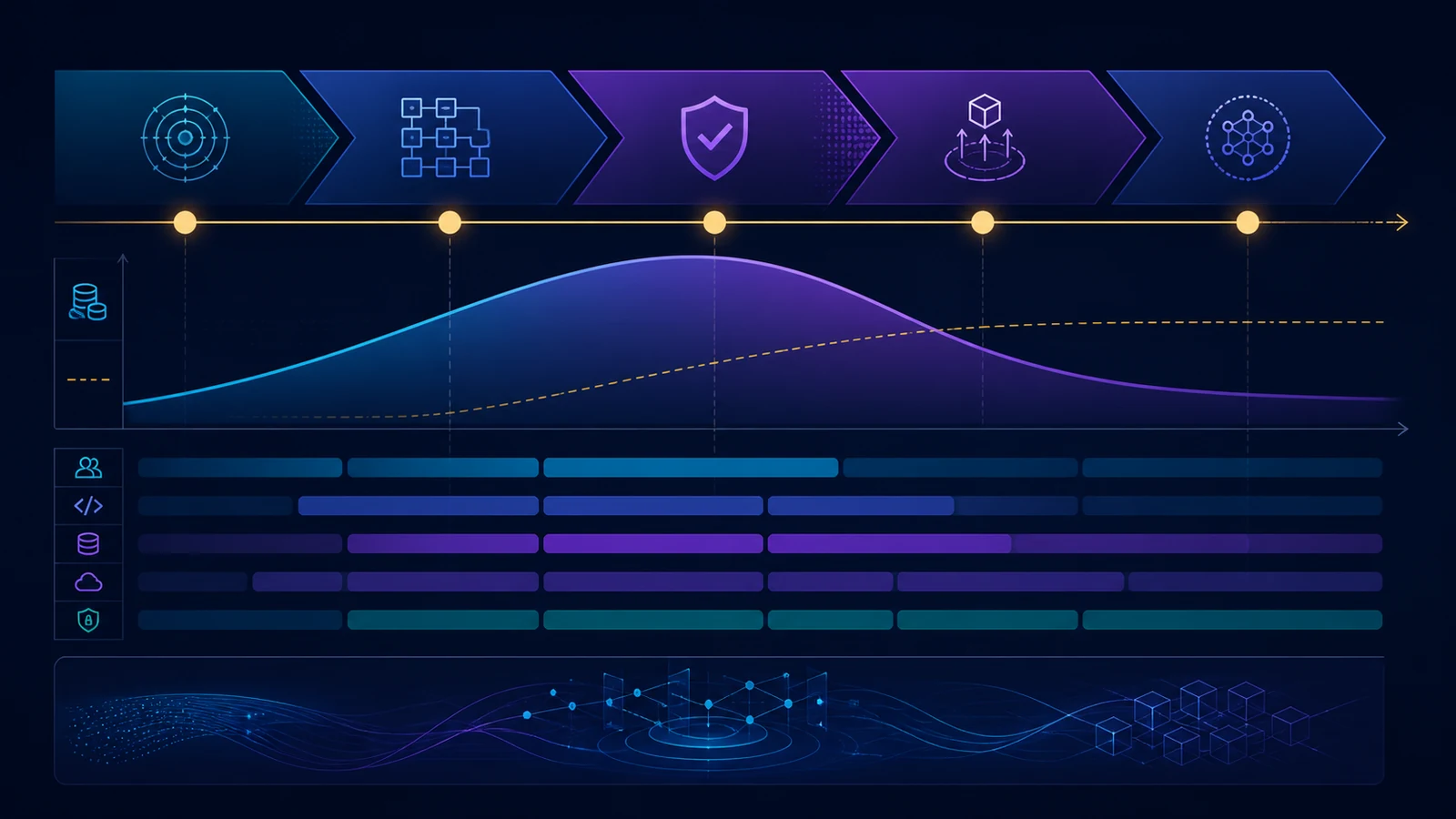
AI agent development commonly ranges from a few weeks for a bounded internal pilot to several months for a production system with sensitive tools, evaluations, integrations, and change management. Cost is driven less by the chat interface than by workflow ambiguity, data access, integration depth, failure risk, and operating requirements.
Planning bands
An internal proof of value for one read-only workflow may take two to four weeks. A controlled pilot with one or two integrations, human approval, run receipts, and a representative evaluation set may take four to eight weeks. A production system spanning customer data, public actions, several business systems, or regulated decisions may take three to six months or longer.
For smaller specialist teams, a bounded discovery and prototype may fall in the tens of thousands of Canadian or US dollars. A production implementation with integrations, security, observability, testing, training, and support can move into the mid-five or six figures. Large transformation programs can exceed that substantially.
Do not compare proposals by the headline total alone. Compare scope, acceptance criteria, reusable assets, client responsibilities, support, model and infrastructure charges, and what happens when a tool returns an unknown result.
What changes cost
Workflow clarity is the first driver. A process with stable inputs, one owner, and a measurable finish line is cheaper than one whose rules live in several people’s heads.
Integration work is the second. Standard APIs are rarely “just connectors.” Authentication, rate limits, pagination, retries, idempotency, field mapping, sandboxes, and production verification consume engineering time.
Risk is the third. Read-only research can tolerate different controls than customer messages, financial actions, production infrastructure, or health and legal workflows. Higher-impact actions require narrower permissions, more evaluations, stronger approval, and incident procedures.
A useful phase plan
Week one should produce the current-state map, baseline volume and effort, target outcome, failure inventory, data sources, owner, and go/no-go criteria. The next phase builds the smallest end-to-end slice in a sandbox.
Before production, create a representative evaluation set, run normal and failure cases, threat-model tool access, instrument latency and cost, and train operators. Roll out to a limited population with a manual fallback. Expand only after accepted-output quality and recovery behavior meet the agreed threshold.
Costs buyers forget
Include model usage, embeddings, vector or database services, browser infrastructure, observability, secrets management, identity, staging, support, prompt and evaluation maintenance, vendor API changes, and internal reviewer time.
The cheapest prototype can become the most expensive system if it has no receipts, portable data, or clear owner. Conversely, not every workflow needs a heavy platform. Match controls to impact.
Evidence to request in a proposal
Ask for a phase-by-phase estimate with assumptions and exit criteria. Require the proposed team, architecture, evaluation approach, security model, integration list, data retention, ownership, documentation, support window, and change-request mechanism.
Ask what will be demonstrated at the end of each phase. “Agent working” is not enough. A useful receipt identifies the accepted workflow, test set performance, known limitations, deployed environment, access model, and operator handoff.
Limitations
These bands are directional and can vary by geography, team model, industry, and existing infrastructure. Current model and cloud prices also change. A credible estimate requires process volume, systems, data classification, decisions, service levels, and internal responsibilities.
Use Agentix AI automation consulting to scope the workflow before committing to a build, or review custom AI agent development for implementation expectations.
Want this converted into an AI workflow?
Share the workflow, team, or bottleneck you want to fix. Agentix will route it into CRM and follow up with a practical implementation path.